
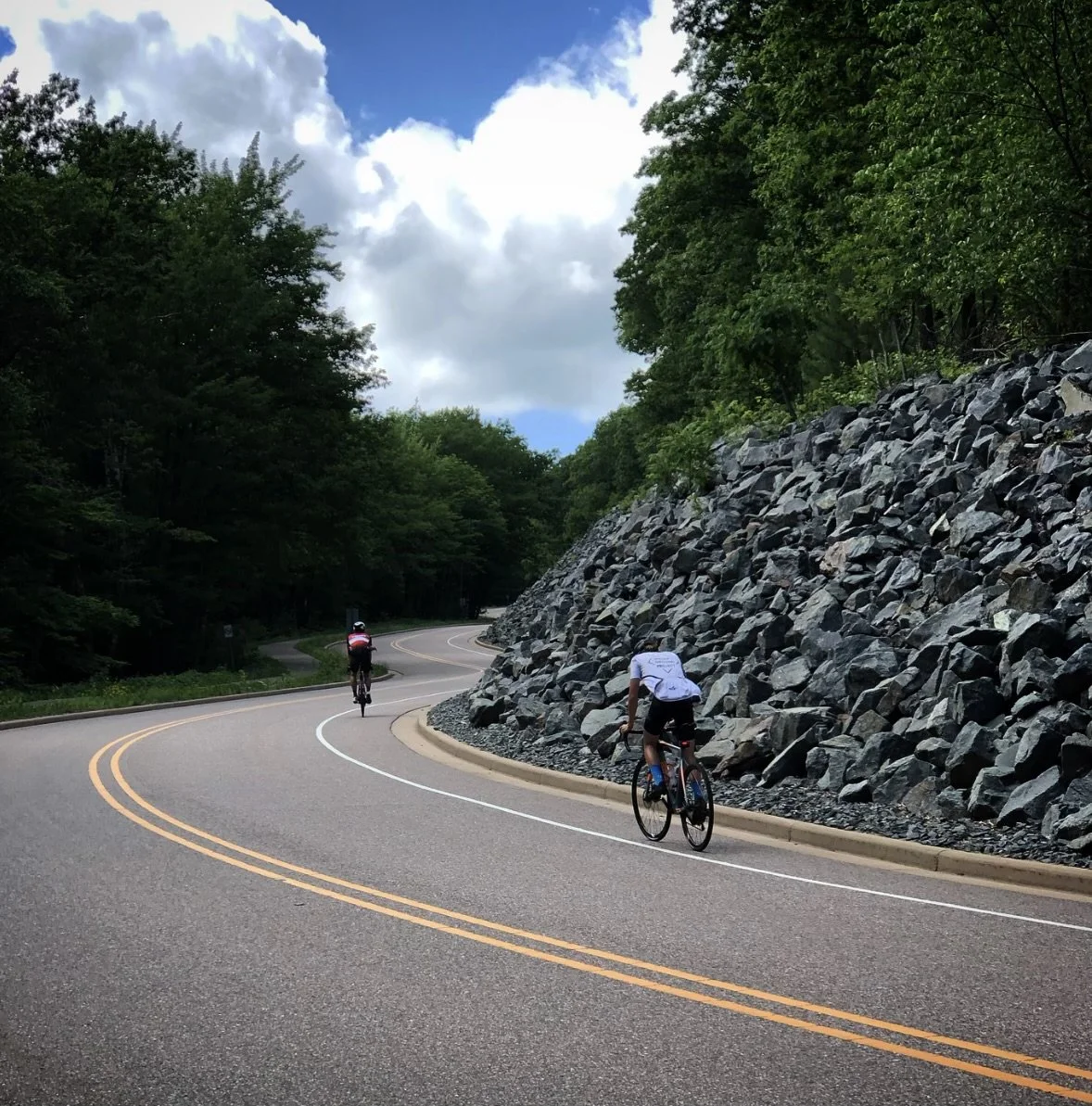
Everesting in Wisconsin??
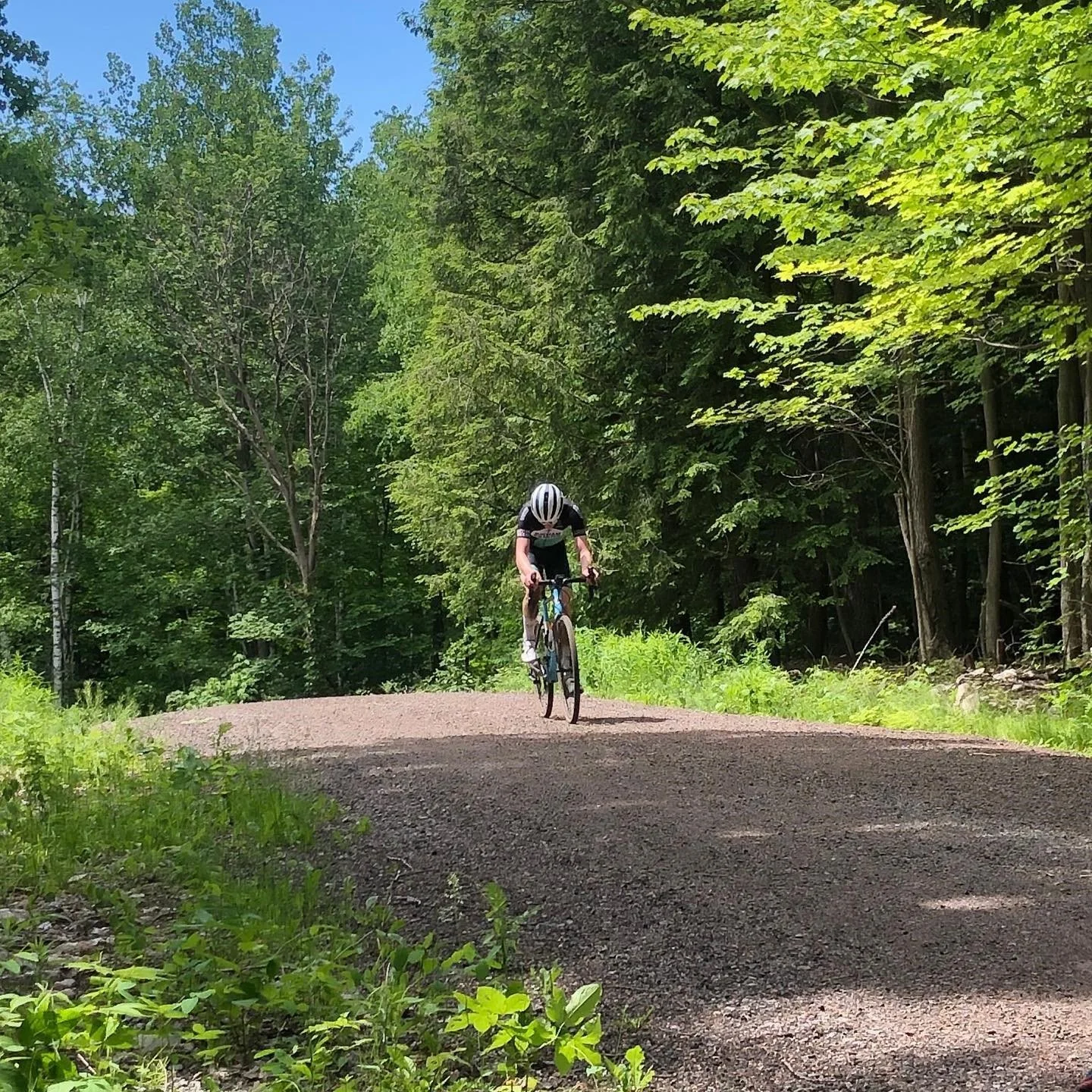
Jake persisted maintaining a minimum power to stay upright (rules do not allow cyclists to push their bike up the hill) riding over the front wheel to prevent from spinning out when the gradient hit 22%. Photo credit Cate Buescher
Climbing uphill 29,029 feet, the equivalent of Mount Everest is a daunting challenge. The challenge even has a name: Everesting, with over 35,000 people officially completing the feat on their bikes or on foot since its inception in 2014 (compared to 7,500 that have actually summitted Mount Everest).
Although Everesting founder Andy Van Bergen loves the racing component of sport, he personally always was more motivated by achieving a personal best, whether it's distance, time, or climb. “After struggling to find an event that would cater to this, I created Everesting - with the idea of encouraging others to achieve their own ambitious personal goals,” said Van Bergen.
The basic rules are simple, tally enough ascents on a single climb without sleeping totaling 29.029 feet of elevation gain. Although opportunities to gain that elevation in the Midwest require many repeats, flatlanders are taking on the challenge. With no time limit, persistence reigns over speed. The flexibility of the timeline, location, steepness, and logistics allows multiple approaches for the personal challenge no matter the background.
I had first heard about Everesting in 2020 when these riders completed the challenge in my backyard. Despite no Everest completions on foot in Wisconsin, these riders paved the way for me to take on my own Everesting challenge and here are their stories that inspired me.
Perfect storm
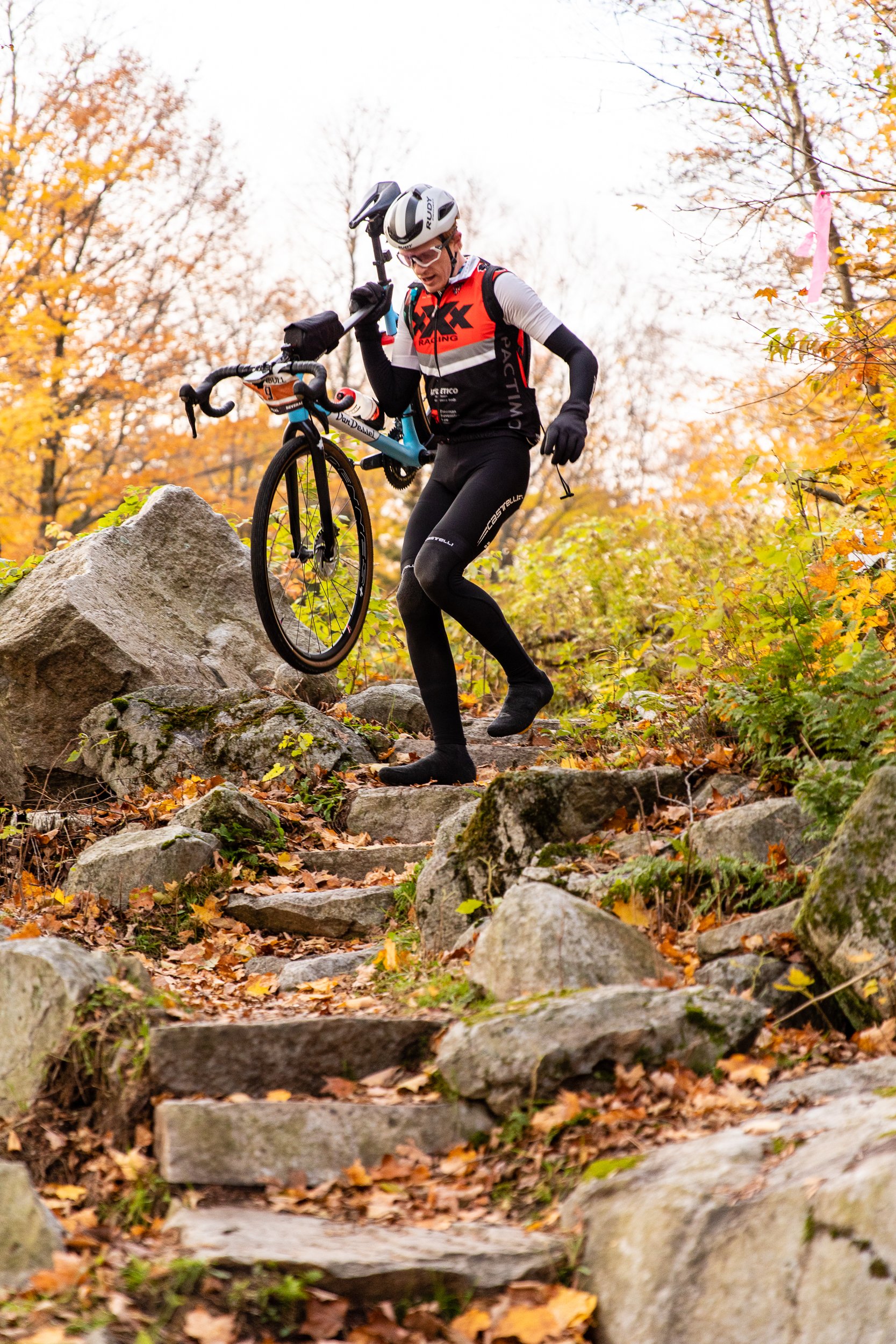
Jake leads the inaugural Red Granite Grinder, his first ever gravel bike race. Photo credit: Gary Barden
“Everesting was a great experience, but I can’t overemphasize how hard it was,” said Jake Buescher. Jake went into his Everest attempt in the best endurance shape of his life. Jake came off his first gravel race in 2019, a win at the Red Granite Grinder, but the pandemic derailed his plan to focus on gravel with no race opportunities. Jake discovered Everesting and seized the opportunity to raise money for Blackstone Bicycle Works, a non-profit empowering youth, creating a perfect storm of a personal challenge to help others.
For Jake, a solo approach suited him to set his own pace rather than ebbing and flowing. Jake was far from solo, with his dad and a friend joining him for the first half of the challenge then one-by-one family members waking up, coffee in hand supporting him.
In a separate attempt, Vince Dinkel joined brothers Casey and Brody Hildebrandt after bumping into each other a week prior while riding on the hill of their planned Everest attempt. Casey spent the spring of 2020 building his endurance, but sought an avenue to test himself. “You do it on your own and it’s easy to walk away, but more rewarding at the end,” said Casey. Vince, a college football player, turned to triathlons after graduation. Everesting drew Vince to his first-ever pure cycling event, reaching all new territory for distance, elevation, and hours on his bike. Brody, age 15, hadn’t even driven that far in a car.
Hill choice
The downside of Midwest Everesting is limited hills, particularly 1-2 mile climbs on straight roads to maintain as much descent speed as possible, but each of these riders found suitable hills in Central Wisconsin.
Jake scoured for an appropriate hill meeting his criteria: 1) drivable from his home in Chicago 2) on gravel 2) less than 200 miles (including descent) to accumulate 29,029 feet to prevent a long slog. The selected hill required a manageable climb of five minutes which fit a sweet spot for Jake based on his criterium and track cycling background. Additionally, the hill had enough variety with a mix of surfaces and allowing shifting with a triple stairstep. Other perks included the ability to set up a home base on private land near bathrooms, mostly forested with no wind and shade, and virtually no traffic with the route on a private driveway (allowing for a best line on turns) and a dead end road. Jake had two bikes at the ready for the attempt. A pre-ride confirmed his gravel bike had a clear advantage with a bigger rear cog with 1:1 gearing, giving him 5 to 10 rpm more and less aggressive treads to ride faster on the downhill.
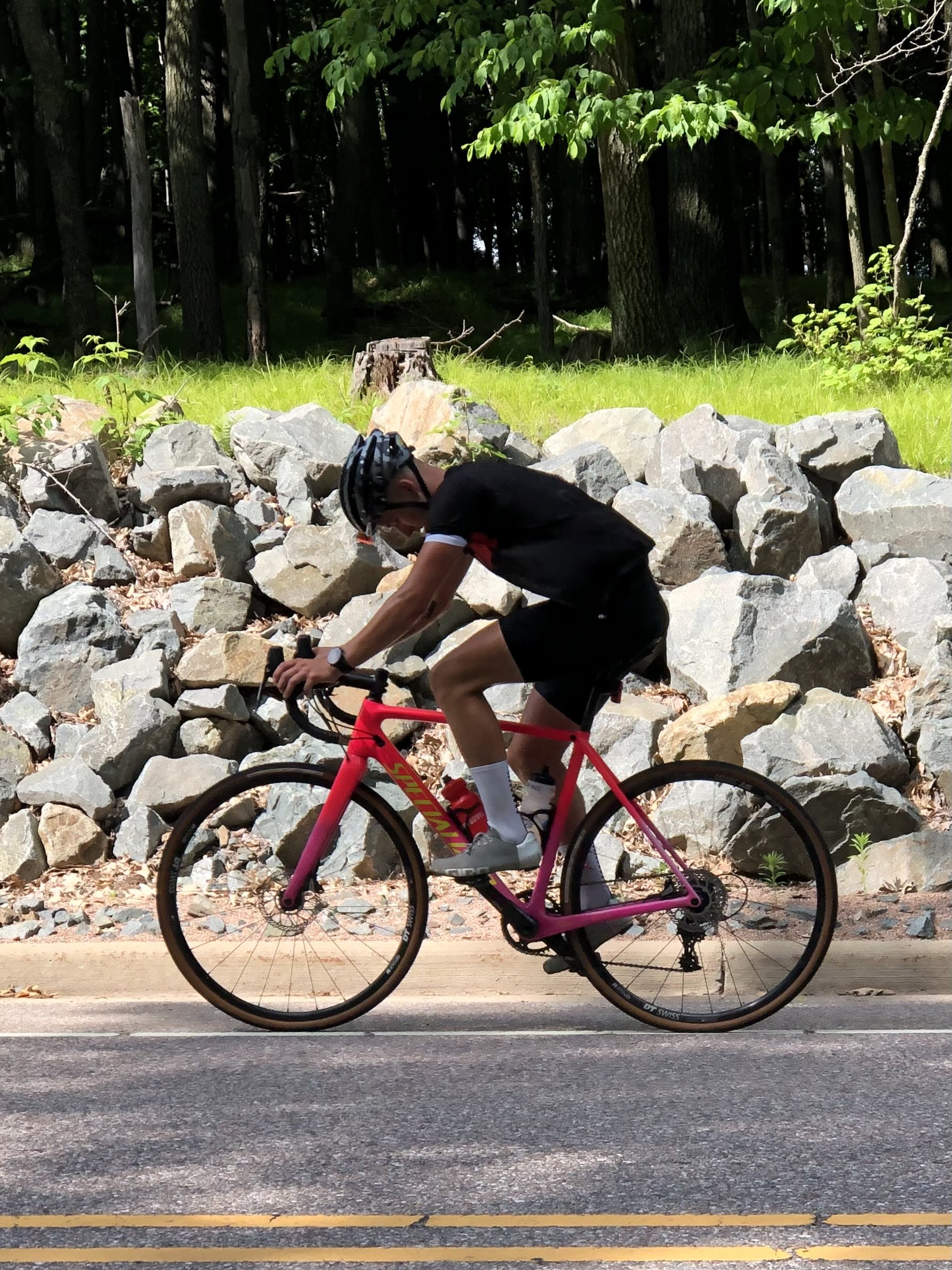
Casey had only his cyclocross bike but switched to a slick tire and smaller chain ring (40/32 cassette) for the challenge. Photo credit: Jenn Schmoldt
For the Hildebrandts, the hill choice was obvious, Rib Mountain State Park, which boasts the highest vertical drop in the Midwest. Casey still recalls shock the first time he summited years earlier. The mild grade proved suitable for late addition Vince’s football physique, maxing out at 13% grade. Since there were a couple of Everesting completions already on the hill, they received pointers, including shortening the hill to maximize the grade (totaling 173 miles over 54 laps) and positioning their aid halfway up the hill to have two passes per lap in case they encountered mechanicals.
Grinding away
Jake didn’t set a time goal until a couple days before when his buddies were coming up with over-unders. Jake set a lofty goal of ten hours, to complete 90 reps totaling 110 miles. When Jake fell off pace, he adjusted his goal to 11 hours but ultimately knew he had to complete the challenge for Blackstone. “It built up a lot of momentum and I couldn’t not finish,” said Jake whose efforts raised $17,000. “It is cool to see how it brought the community together.”
Jake flew through the first half eclipsing the five hour mark with only three minutes of stoppage, razor focused on hitting splits and power numbers. But 2/3 of the way in, he couldn’t take in calories anymore and got off his bike in an absolute daze. Jake dug deep on fumes, finishing under 11 hours, which stood as the fastest Everest on soil for a year.
For Jake, not only was the weather ideal, but his mental and physical preparations dialed. “I don’t think I could have done anything different or better with my training or resources in the Midwest,” said Jake. With the absence of hills in Chicagoland, he did most of his training on Zwift with books under his front wheel for 5-10 minute repeats to mimic the grade. He completed his longest ride of 240 miles three weeks prior, so he was mentally prepared to sit in the saddle from sun up to sun down. Jake analyzed a GPS file of the private driveway to devise a pacing and fueling strategy, which became clockwork. “Everesting is different than race scenarios when there are a lot more variables in play such as other riders and obstacles,” said Jake.
Weather challenges
On the other hand, weather added to the trios’ challenge. Substantial rain delayed their attempt, taking a mental toll on Casey. “I was so fixated that it added to the nervousness of the challenge,” said Casey. During the attempt, the weather turned from sweltering heat to bone-chilling rain. Brody continued unphased even after a crash halfway. Vince and Brody persisted into the rain and darkness beyond their light’s battery life, which served as Vince’s biggest hurdle. “Once I started, I knew I wouldn’t quit unless my body couldn’t keep going,” said Vince.
Reaching the summit
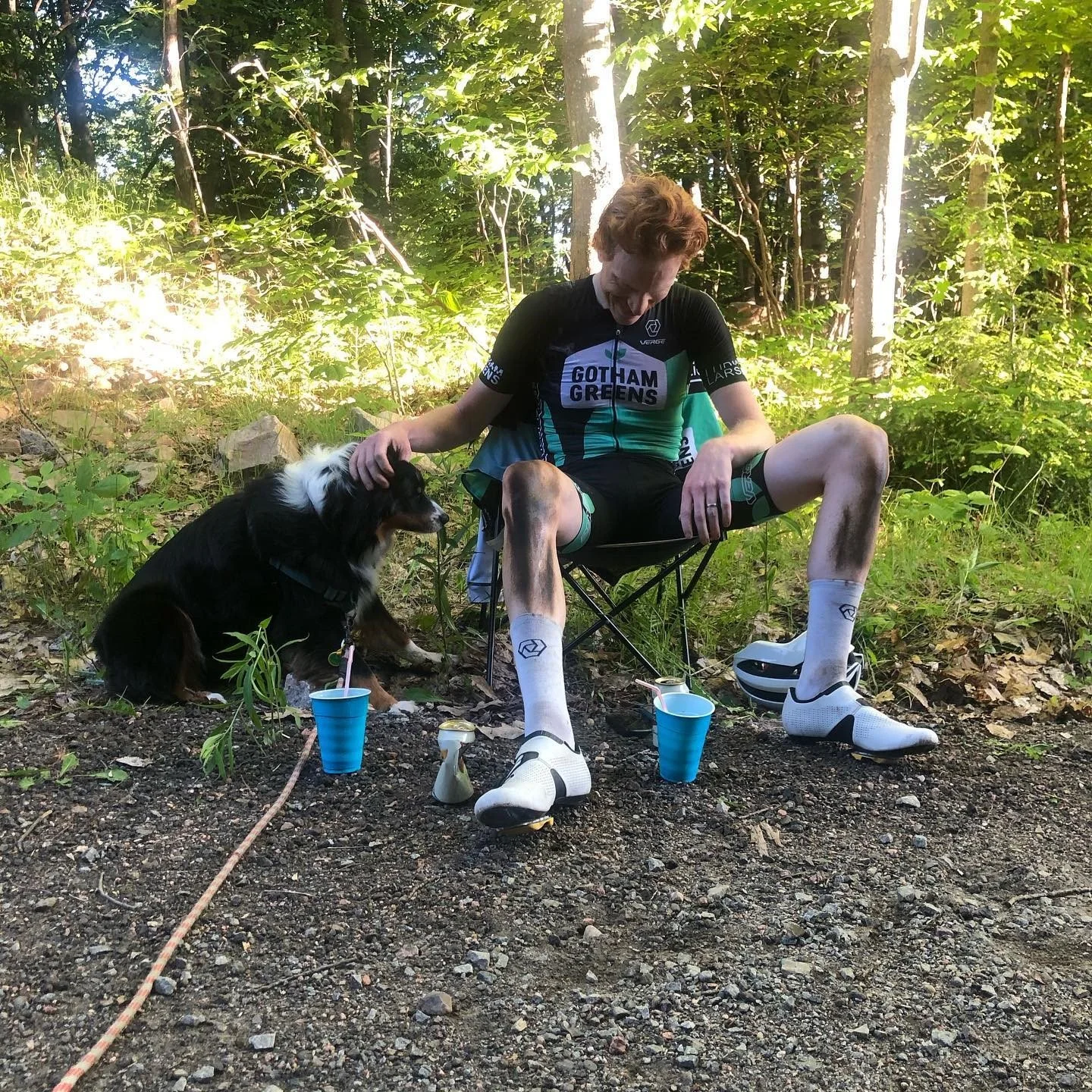
Jake celebrates quietly. Photo credit Cate Buescher
“The toll it took was really hard,” said Jake. “Everesting takes the cake with a total different breakdown. The double digit gradients require pedaling in a small ring with high resistance for 10 to 12 hours, something you never do.” Jake’s finish was anticlimactic since his home base was at the top of the hill, and Everesting rules require riders to complete the lap. After he eclipsed 29,029 feet, he descended then completed a bonus climb which took three times longer to return. As his family celebrated, Jake fixated on getting the data uploaded to Strava (a requirement to be in the official Hall of Fame). With the huge file and limited signal, Jake held his device to the sky for several minutes.
Brody had a similar experience, becoming fixated on his Garmin which froze up on his final repeats until Casey pulled him off in the dark and rain after convincing him he had reached the goal. For Casey, the highlight wasn’t his, but his brother’s accomplishment. Vince broke the challenge into manageable bits through “mental gymnastics”, but what really took him off guard was how he’d feel the next day just to get off the couch, but bounced back and hit the saddle three days later.
Takeaways
Trainer, treadmill, stairwell, or driveway. Climbing Everest in our backyard without contending with a mountain and the lack of oxygen, altitude, temperature swing, and wind is a personal challenge accessible to even us flatlanders. “Make sure you’re mentally prepared and commit to it,” said Jake. “You need to mentally prepare for the obstacles you will face, there will be times you will want to give up,” said Casey. “Stick with it even it if takes all days and take breaks if needed,” added Vince.
As exemplified by each of these riders, all with little to no road riding background and varying amounts of preparation, that the challenge is suitable for a wide range of experience levels. Each found they are capable of incredible feats which carries into all facets of life. “It puts anything you do on a bike, in fact in life, in perspective,” said Jake.
Banner photo: The trio publicized their goal and eleven local cyclists joined which served as a catalyst of friendships and subsequent adventures in the saddle. Photo credit: Jenn Schmoldt
Related:
Wausau resident sets American record Wausau Pilot & Review